Best Monitor for Video Editing: What Really Matters
Your monitor is how you judge colour, contrast and detail. If it's inaccurate, every grade and export is a guess. You don't need a reference display to start, but you do need the right specs. Here's how to choose.
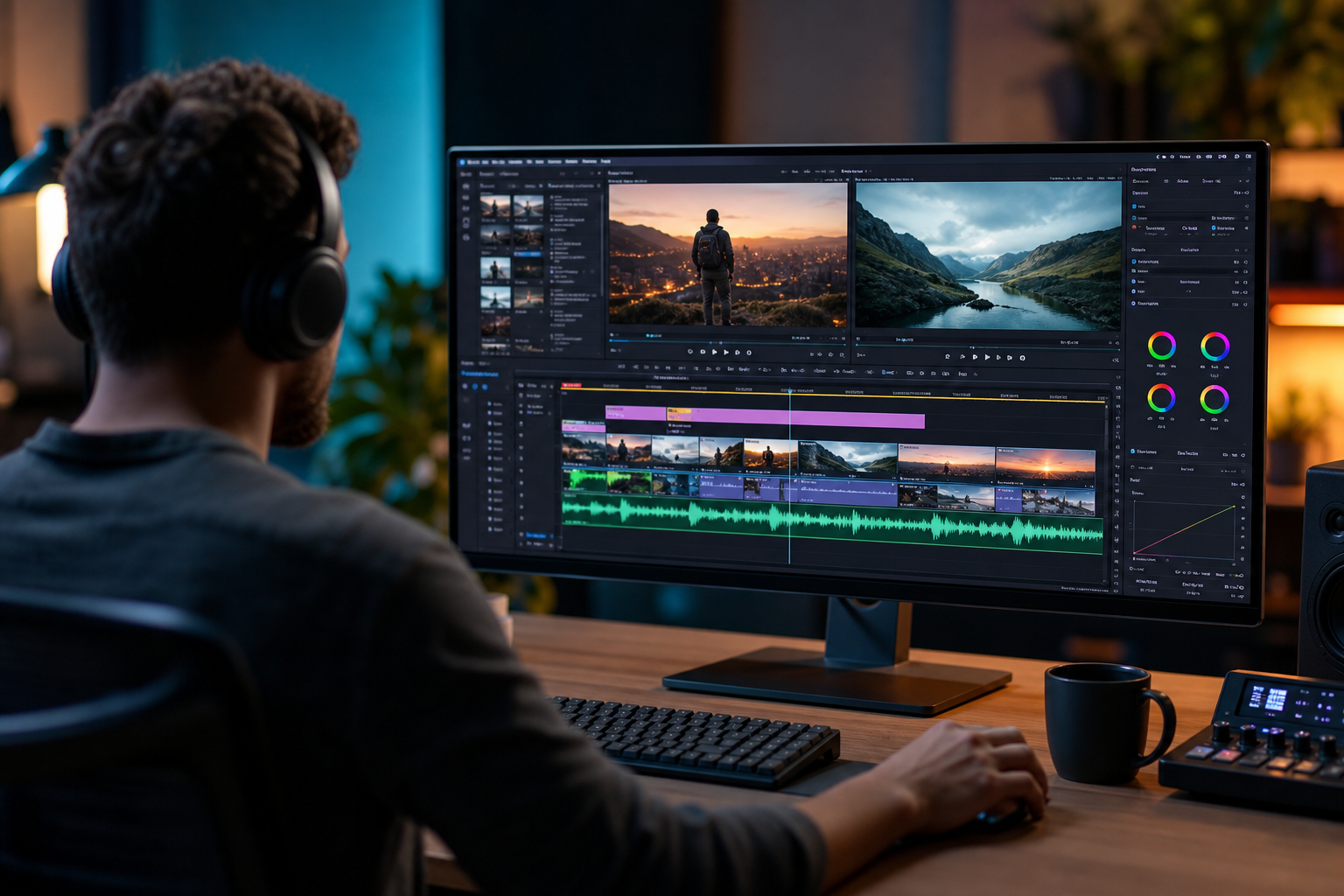
Key Specs Explained
| Spec | What to look for |
|---|---|
| Panel type | IPS for accuracy and viewing angles; OLED for contrast (watch for burn-in) |
| Resolution | 1440p at 27" minimum; 4K for 4K editing |
| Colour gamut | 100% sRGB/Rec.709 for web and YouTube; 90%+ DCI-P3 for HDR and cinema |
| Accuracy | Factory calibration with Delta E under 2 |
| Bit depth | 10-bit (or 8-bit + FRC) for smooth gradients |
| Connectivity | USB-C with power delivery for laptops |
Recommendations by Budget
| Budget tier | What you get | Good for |
|---|---|---|
| Entry | 27" 1440p IPS, ~100% sRGB | YouTube and social editing |
| Mid | 27" 4K IPS, factory calibrated, USB-C | 4K editing and serious colour work |
| Pro | Wide-gamut, hardware-calibrated displays (e.g. BenQ SW, ASUS ProArt, EIZO ColorEdge) | Professional grading and HDR |
Popular creator lines include BenQ PD and SW, ASUS ProArt, Dell UltraSharp, LG UltraFine and EIZO ColorEdge.
Calibrate Your Monitor
- Let the monitor warm up for 30 minutes.
- Use a hardware calibrator (colorimeter) and its software.
- Target D65 white point, gamma 2.4 (dim room) or 2.2 (bright room), and 100 to 120 nits for SDR.
- Recalibrate every month or two.
Most budget laptop screens aren't colour-accurate. An external calibrated monitor is the single biggest upgrade for colour work; see best laptop for video editing under ₹60,000.
Want colour you can trust?Our colourists grade on calibrated displays. Try a free sample.
Claim Your Free 60-Sec EditComplete Your Setup
- Best graphics card for video editing
- Best PC build for video editing
- Best video editing laptop
- Put it to use: how to color grade in Final Cut Pro
- Best video editing software for professionals
Accurate colour builds trust in your brand. A video production company in India like EditAtEase grades your videos on calibrated displays so they look right everywhere.
Frequently Asked Questions
What monitor is best for video editing?
A colour-accurate IPS monitor with at least 100% sRGB coverage, 1440p or 4K resolution and factory calibration is best for most editors.
Do I need a 4K monitor for video editing?
Not for 1080p work, but it helps for 4K footage, giving you more timeline space and letting you check fine detail.
Is an OLED monitor good for video editing?
OLED offers excellent contrast and colour, but check for burn-in risk with static interfaces and verify colour accuracy.
How often should I calibrate my monitor?
Every one to two months for colour-critical work, using a hardware colorimeter.
Stop Editing. Start Creating.
You record, we edit. EditAtEase turns your raw footage into scroll-stopping YouTube videos, Shorts, Reels and podcasts, so you post consistently and finally get your week back.