What Is B-Roll? Meaning, Types and Examples
Watch any well-made YouTube video, documentary or brand film and you'll notice the speaker isn't on screen the whole time. The camera cuts to their hands at work, the product up close, the city outside, a screen recording. That supporting footage is B-roll, and it's one of the biggest differences between amateur and professional video.
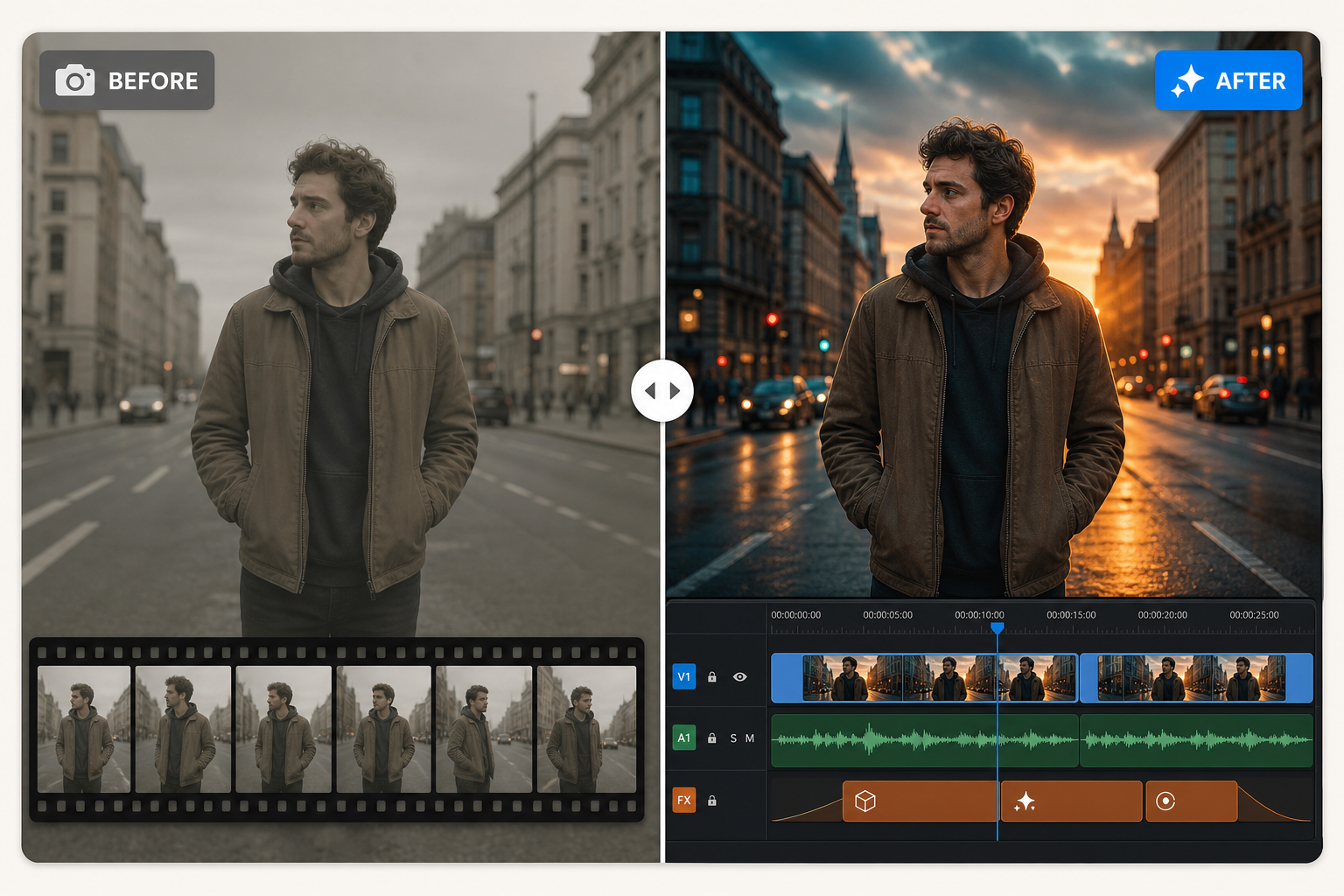
B-Roll Meaning: The Simple Definition
B-roll is supplementary footage that plays alongside or over your main footage to illustrate, support or add context to what's being said. The main footage, usually a person talking to camera, an interview or the core action, is called A-roll.
In a cooking video, the A-roll is the chef explaining the recipe; the B-roll is the close-up of onions sizzling, the spice being sprinkled and the finished dish. In a tech review, the A-roll is the reviewer talking; the B-roll is the phone rotating on a turntable and screen recordings of the camera app.
If you could remove the footage and the video would still make sense through audio alone, it's probably B-roll. If removing it breaks the story, it's A-roll.
A-Roll vs B-Roll: What's the Difference?
| A-roll | B-roll | |
|---|---|---|
| Role | Carries the main story or message | Supports, illustrates and adds variety |
| Typical content | Talking head, interview, presenter, main action | Close-ups, cutaways, scenery, products, screen recordings |
| Audio | Usually the primary dialogue track | Often silent or natural sound under the A-roll audio |
| On screen | Continuously or most of the time | In short bursts, typically a few seconds each |
| Can the video work without it? | No | Yes, but it will feel flat and static |
Where Does the Term "B-Roll" Come From?
The term dates back to film and early tape-based editing. Editors worked with physical rolls: the main footage sat on the "A" roll, and the supporting footage was placed on a separate "B" roll so the two could be combined and switched between during printing or tape-to-tape editing. Timelines became digital long ago, but the names stuck. Today "B-roll" simply means any supporting footage, whatever device or software you use.
Why B-Roll Matters
- It holds attention. Changing what's on screen every few seconds resets the viewer's focus, which is crucial for retention on YouTube and short-form platforms.
- It shows instead of tells. Saying "the stitching is high quality" is weaker than showing a macro shot of the stitching.
- It hides edits. When you cut out a pause or mistake, the visible jump in the A-roll can be covered with B-roll. Our guide to the jump cut explains when to hide cuts and when to leave them visible.
- It sets mood and place. A shot of rain on a window or a busy Bangalore street tells viewers where and when they are without a word.
- It adds production value. Even simple B-roll makes a phone-shot video feel planned and professional.
8 Types of B-Roll (With Examples)
| Type | What it is | Example |
|---|---|---|
| Cutaway | A shot of something the speaker mentions | Speaker says "my morning coffee" → shot of coffee being poured |
| Establishing shot | A wide shot showing location | Drone shot of an office building before an interview |
| Insert / detail shot | A close-up of a specific detail | Fingers typing, a product's buttons, a signature |
| Process shot | Showing something being done | A designer sketching, a chef plating, a mechanic fixing an engine |
| Screen recording | Capture of a computer or phone screen | Walkthrough of an app during a software tutorial |
| Reaction shot | Someone responding to what's happening | A podcast guest laughing while the host tells a story |
| Stock footage | Licensed footage from a library | Generic city timelapse, crowd shots, nature scenes |
| Archival footage / photos | Historical clips, old photos, news footage | Childhood photos in a founder's story video |
Many editors also treat motion graphics, animated charts and text-based visuals as a kind of B-roll, since they serve the same purpose: illustrating the A-roll. If you use on-screen text this way, our guide on how to add text to a video covers placement and readability.
B-Roll Examples by Video Type
YouTube talking-head video
Screen recordings, product close-ups, relevant stock clips, quick lifestyle shots of the creator, memes or reaction GIFs used sparingly.
Brand or corporate video
Team members at work, the office exterior, product manufacturing, customers using the product, close-ups of the logo or packaging.
Video podcast
Wide shots of both hosts, reaction shots, hands gesturing, and visuals of topics discussed, such as articles or charts.
Real estate or travel video
Walkthrough gimbal shots, drone footage, interior details, timelapses of the neighborhood.
Wedding film
Décor details, the venue at golden hour, rings, hands, guests dancing, and slow-motion moments. Slow-motion B-roll is especially popular here; see our guide on how to slow down a video for how to make it smooth.
Have great A-roll but no time to source and place B-roll?Our editors build B-roll-rich edits from your footage. Try a free sample.
Claim Your Free 60-Sec EditB-Roll Editing Techniques You'll See Everywhere
- J-cuts and L-cuts: letting audio lead or trail the B-roll so the switch feels smooth. Read our full guide to J-cuts and L-cuts.
- Speed changes: timelapses and sped-up process shots compress long tasks into seconds. See how to speed up a video.
- Reversed clips: a pour that flows back into the bottle or a rewind effect makes playful B-roll. Learn how to reverse a video.
- Montages: several short B-roll clips merged into a sequence and cut to music.
- Tight trimming: most B-roll shots work best at 2 to 5 seconds, so precise trimming matters. Our guide on how to trim a video shows how.
Where to Get B-Roll
| Source | Pros | Cons |
|---|---|---|
| Shoot it yourself | Unique, on-brand, matches your A-roll | Takes planning and time |
| Free stock sites (Pexels, Pixabay, Mixkit) | Free, fast | Generic; others use the same clips |
| Paid stock libraries | Higher quality, more variety, clearer licenses | Cost per clip or subscription |
| Screen recordings | Perfect for tutorials and software content | Can look dull without zooms and highlights |
| AI-generated video | Can create shots that are hard to film | Can look artificial; check platform disclosure rules |
Always check licensing. Using footage from films, TV shows or other creators without permission can lead to copyright claims.
B-Roll Trends in 2026
- Faster B-roll cadence on short-form: visual changes every 1 to 3 seconds in Reels and Shorts.
- Authentic over polished: handheld, behind-the-scenes phone B-roll often outperforms glossy stock footage because it feels real.
- AI-assisted sourcing: editors use transcripts to find where B-roll is needed and AI tools to suggest or generate clips.
- B-roll banks: creators and brands build libraries of reusable B-roll so every video doesn't start from zero.
Next Step: Putting B-Roll to Work
Knowing what B-roll is is the easy part. Knowing when to cut to it, how long to hold it and how to shoot it is where the craft lies. Our practical guide on how to use B-roll in videos walks through planning, shooting and editing step by step.
If you'd rather focus on your A-roll and leave the rest to specialists, a video production company in Bangalore like EditAtEase can plan, source and edit B-roll so every video looks polished.
Frequently Asked Questions
What does B-roll mean in video?
B-roll is supplementary footage used alongside or over the main footage (A-roll) to illustrate what's being said, add context, hide edits and keep the video visually interesting.
What is the difference between A-roll and B-roll?
A-roll is the main footage that carries the story, such as an interview or a person talking to camera. B-roll is the supporting footage, such as close-ups, cutaways, scenery and screen recordings, shown over or between the A-roll.
Why is it called B-roll?
The name comes from film and early tape editing, when main footage was kept on an "A" roll and supporting footage on a separate "B" roll so the two could be combined. The term stayed in use after editing became digital.
What are examples of B-roll?
Common B-roll examples include close-ups of a product, a chef chopping vegetables, establishing shots of a building, screen recordings in a tutorial, reaction shots in a podcast and stock footage of a city.
Where can I get free B-roll footage?
You can shoot your own B-roll with a phone, or use free stock sites such as Pexels, Pixabay and Mixkit. Always read each site's license before using clips, especially in ads.
Stop Editing. Start Creating.
You record, we edit. EditAtEase turns your raw footage into scroll-stopping YouTube videos, Shorts, Reels and podcasts, so you post consistently and finally get your week back.